Firmographics are the facts about a company, such as industry, headcount, revenue, and location, that you use to decide whether it belongs on your list.
If you sell payroll software, "HR teams at companies with 80 to 400 staff in the EU" is a firmographic filter. Get it right and your outbound list shrinks to companies that can buy. Get it wrong and you spend weeks emailing businesses that were never going to sign.
I use firmographics every time I describe an ideal customer, including in Openlead. Here's the definition, the types, and how to put them to work.
In short
- Firmographics are company facts such as industry, headcount, revenue, and location.
- You use them to decide which companies belong on a list, before you pick the people.
- Start from customers you already won, turn those fields into one sentence, then build and check the list.
- Openlead takes that sentence and returns companies that match, with a link to each source.
What is firmographics?
Firmographics (sometimes called firmographic data) are attributes of an organization HubSpot's guide (updated 4 February 2025) draws the same line: demographic data focuses on individuals, and firmographic data focuses on the organization.
Typical fields include industry, company size (staff or revenue), headquarters and office locations, ownership (public, private, nonprofit), and whether the company is growing or shrinking. Job title and seniority sit next to this, but those describe a person, so I treat them as a separate layer (the buyer persona).
Firmographics are not technographics (the tools a company uses) and not intent data (signals that a company is researching a topic right now). You can combine all three. The firmographic layer answers a simpler question first: is this the kind of company I sell to?
Why firmographics matters
Without firmographics, a "decision maker" list is only a title list. You end up pitching a 12-person shop a product built for 2,000-person companies, or chasing a US-only tool into a market it can't serve. The business consequence is wasted spend: you buy contacts, write emails, and book meetings with companies that can't buy.
I also use firmographics to size a market. If I can count how many companies in Germany have 50 to 200 people in B2B SaaS, I know whether the territory can support a hire. That count is only as good as the fields behind it, which is why I care about how each field is defined (see the limitations below).
Types of firmographics
1. Industry and sector
Industry is the category the company operates in: software, logistics, healthcare, professional services. Many companies sit in more than one. A payroll firm that also sells HRIS will show up under both if you search too loosely. I write the industry in the buyer's language ("B2B payroll for companies with staff in two countries"), then map it to the database field I have.
2. Company size
Size is usually headcount or revenue, sometimes both. Headcount is easier to find and is often good enough. Revenue is better when price depends on spend (for example, a tool that bills as a share of payroll). A 40-person agency and a 40-person factory are the same size and almost never the same buyer.
3. Location
Location can mean headquarters, billing country, or where the staff actually sit. If you sell into the EU for a data-residency reason, HQ in London with a team in Berlin is a different case from HQ in Austin with no EU office. Be specific in the ICP about which location you mean.
4. Ownership and funding
Public, private, venture-backed, bootstrapped, nonprofit, government. A Series A fintech and a 30-year family business can share an industry and a headcount and still buy in completely different ways. Funding stage is a firmographic I use a lot for software buyers.
5. Growth and structure
Is the company hiring, shrinking, or stable? How many offices? Is it a parent with subsidiaries? Growth is useful when your product helps a team that is adding people. Structure matters when the buyer sits in a subsidiary you would miss if you only looked at the parent.
How to use firmographics, step by step
Step 1: Start from customers you already won
List 10 to 20 of your best customers. Write down industry, headcount, country, and any other field that actually showed up in the deal (funding stage, number of entities, a specific department size). Drop the fields that were true of a customer but didn't affect the sale.
Step 2: Turn those fields into one sentence
Write a single ICP sentence a stranger could use: "B2B SaaS companies in Germany, 50 to 200 people, selling to HR teams." That's firmographics plus the person you sell to. I go deeper on that split in buyer persona vs ideal customer profile.
Step 3: Build the company list, then pick the people
Filter a database or a search tool with those fields, and only then pick titles. If you start with titles, you get "Heads of People" at companies of every size. For tools that do this job, I keep a lead database roundup and an account list builder roundup.
Step 4: Check the list against reality
Spot-check 20 companies. Are they really in the industry you meant? Is headcount in the band? Did a subsidiary sneak in? Then run a small outbound batch and see which firmographic band actually replies. Adjust the sentence. Don't add five more filters to hide a weak offer.
Firmographics examples
-
Payroll software: EU companies with 80 to 400 staff, payroll in at least two countries, HR team of three or more. Exclude nonprofits if the product doesn't support them.
-
Warehouse robotics: Manufacturers or 3PLs with 200 or more staff and at least one site over 10,000 square meters in the US Midwest. - Fractional CFO service: Bootstrapped B2B services firms in the UK, 15 to 60 people, no in-house finance lead, revenue roughly $2M to $10M.
Each example is a filter you can hand to a tool or to a researcher. If you can't write one like this, you don't have an ICP yet; you have a wish.
Tools for firmographics
You can collect firmographics yourself (Companies House, the imprint page, LinkedIn, a 10-K) or pull them from a database. Company databases and account-list tools are the usual next step. Start with the lead database and account list builder lists. Use the Crunchbase alternatives if funding data is the field you care about. Openlead sits earlier: you describe the firmographics in a sentence and get matching companies back.
Challenges and limitations
- Stale fields: Headcount and industry lag reality. A company that was 80 people last year may be 140 now. Spot-check before you buy a large contact batch. - Messy industry labels: Two databases will file the same company in different sectors.
Write the ICP in plain words, then see how each tool maps it. - Size bands that are too wide: "10 to 5,000 employees" is not a filter. Narrow it until a week of outbound would actually cover the list. - Confusing the company with the person: Title-only lists skip firmographics and waste budget. Keep the company filter first.
A worked example
A payroll product only fits EU companies with 80 to 400 staff and an HR team. That is a firmographic filter: region, headcount, and function. I would write it as one sentence, build the company list, then pick HR or finance leads at each firm.
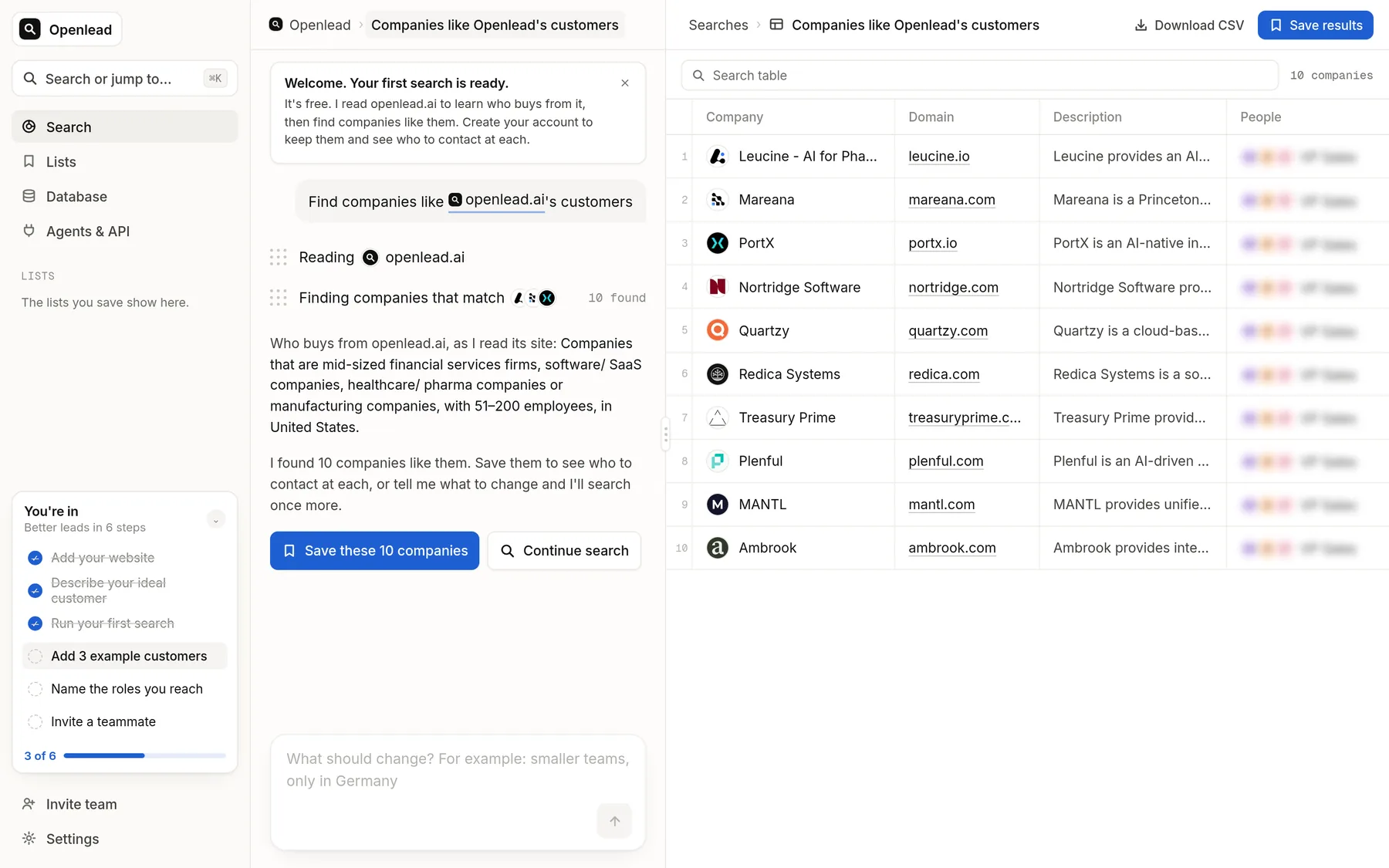
The public Openlead try flow does this from a website: it reads who already buys, and it searches for similar companies. In the try-results capture earlier in this article, the size, industry, and country are part of that description.
How firmographics work in Openlead
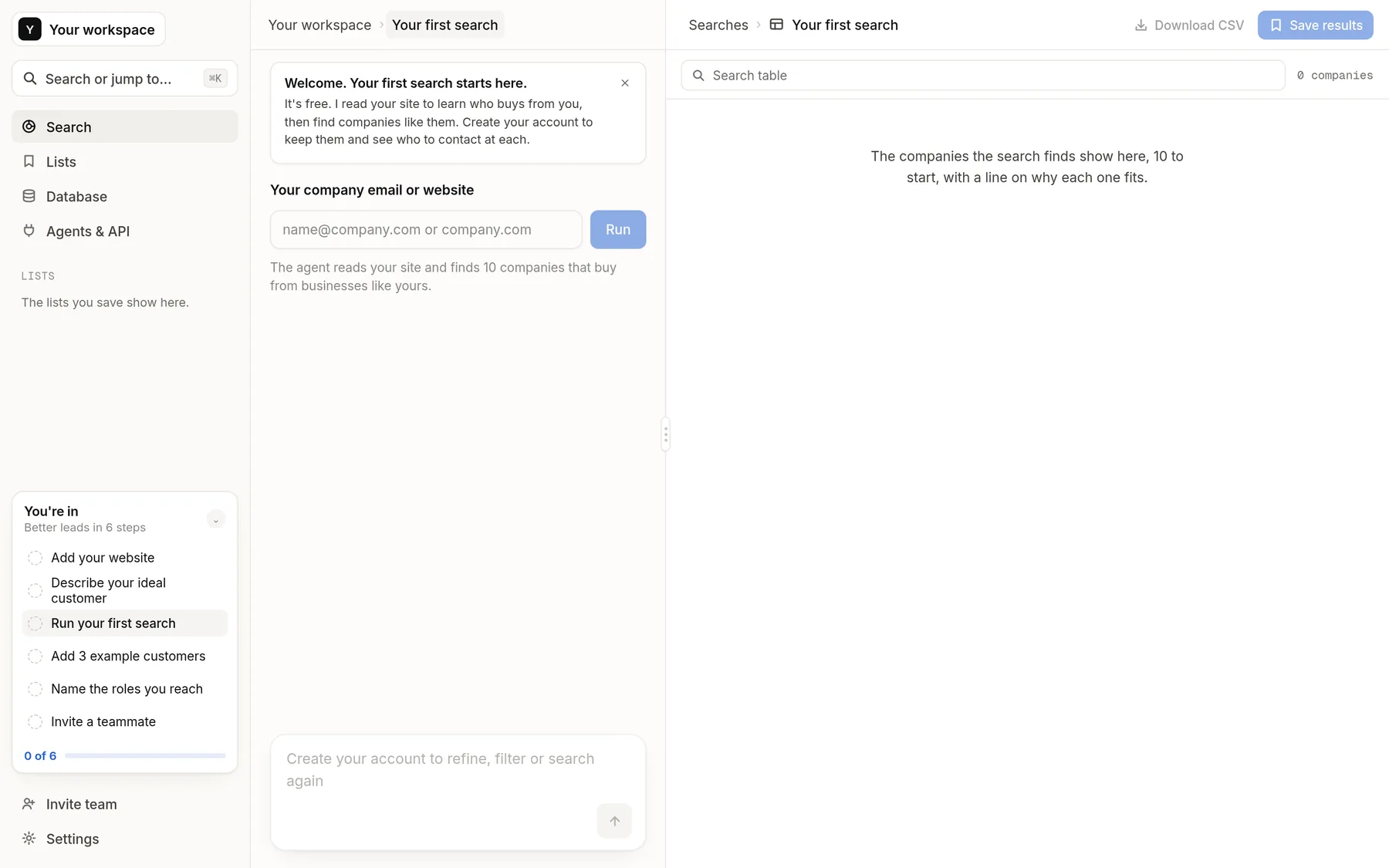
In Openlead you type the firmographics in plain words, the same way you'd tell a researcher: "Series A fintechs in Germany with 50 to 200 people." You get companies that match. Each one comes with 1 to 3 relevant people and their profile links.
Openlead does not give email addresses, phone numbers, or intent signals. Use it to lock the company list, then use a contact tool only on that list.
Frequently asked questions
What is firmographic data?
Firmographic data is information about a company, such as industry, size, location, revenue, and ownership. It describes the organization, not the individual buyer.
What are examples of firmographics?
Common examples are industry, employee count, annual revenue, headquarters country, funding stage, and number of offices. "Head of HR" is not a firmographic; it is a job title.
What is the difference between firmographics and demographics?
The main difference between firmographics and demographics is the unit they describe. Firmographics describe a company. Demographics describe a person (role, seniority, location of the individual).
How are firmographics different from technographics?
The main difference between firmographics and technographics is the kind of fact: firmographics are company traits such as size and industry, and technographics are the technologies the company uses.
Why do firmographics matter in B2B sales?
They keep you from spending outreach on companies that can't buy. A tight firmographic filter shrinks the list to accounts in your size, industry, and location band, which is the first test of an ICP.
About the author
Julian KrethFounder, Openlead


