A good B2B cold email template is short, names a specific company fact, and asks for one small next step. Most templates fail because they could be sent to anyone, and because they pitch the product in sentence one.
I write outbound around the list first: if the company was never a fit, no template will save the email. On 13 November 2026 I also re-read the US CAN-SPAM rules, because a clever template that breaks those rules is still a bad email. Below you'll find 8 B2B cold email templates you can copy, plus the steps I use before I send anything, and the mistakes I keep seeing.
In short
- A good B2B cold email template is short, names a specific company fact, and asks for one small next step.
- Build the list first. A clever template will not save an email to the wrong company.
- Follow the email rules that apply, including CAN-SPAM in the US.
- Openlead finds the companies and the people. It does not provide email addresses.
What is a B2B cold email template?
A B2B cold email template is a reusable outline for a first (or second) note to someone who didn't ask to hear from you.
A good one leaves room for a real detail: a hire, a product launch, a location, or a number from their site. The template is the skeleton. The personal line is what earns the reply. I would rather send 40 specific emails than 400 that share only a first name.
What you need before you write one
- Your ICP in one sentence (industry, size, location, the problem you solve). The buyer persona vs ideal customer profile split helps: the ICP picks the company, the persona picks the person and the language. - A short list of companies that actually fit, with 1 to 3 people at each.
I build that list in Openlead before I write. - A verified work email. A B2B email finder plus a verifier is the usual path. - One ask: a 15-minute call, a yes/no question, or a short clip.
How to write a B2B cold email in 4 steps
Step 1: Open with them, not with you
The first line should prove you looked at the company. A hire, a market, a sentence from their site, a product they launched. If you can swap the company name and the email still works, rewrite it.
Step 2: Name the problem in their language
One or two sentences on the problem, tied to that company fact. Don't list five features. Don't claim a result you can't defend.
Step 3: Ask for one small next step
A 15-minute call, a yes or no, or "worth a look?" are easier to answer than "can I show you the platform." Make it easy to decline, too. People reply more when the email doesn't trap them.
Step 4: Keep it short and compliant
Aim for 50 to 125 words. Use a subject line that matches the body.
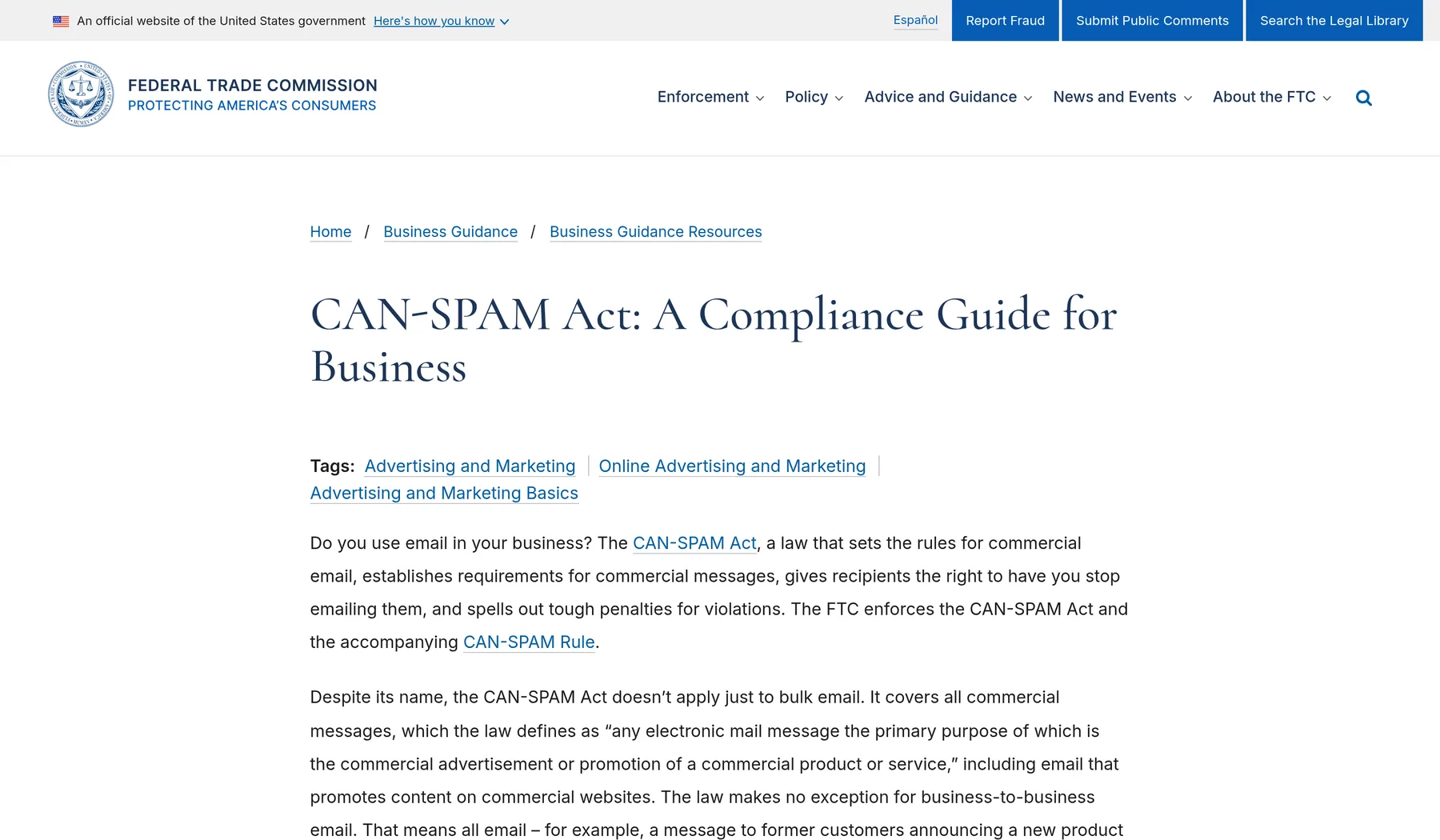
Follow the FTC's CAN-SPAM guide if you email people in the US: honest subject and headers, identify the message as commercial, include a physical postal address, and honor opt-outs. In the EU and UK, check GDPR before you press send. I wouldn't buy a raw file and pour it into a template; the reasons are in buy B2B leads.
8 B2B cold email templates by situation
Replace the brackets with real details. If a line is still generic after you fill it in, cut it.
1. First note after a relevant hire
Subject: [New role] at [Company]
Hi [First name],
I saw [Company] hired you as [role] earlier this [month or quarter]. Congrats.
Teams in that seat often ask how to [specific problem you solve, in their words], especially when [one company fact: new market, headcount band, product launch].
Would a 15-minute call next week be useful, or should I leave this with you?
[Your name] [Your company] · [Postal address]
When to use it: the person is new in post and the problem is part of the job they were hired to do. It works because the first line could only be about them.
2. First note from a company fact on their site
Subject: [Specific page or product] at [Company]
Hi [First name],
I read the [page or announcement] on [Company]'s site, the part about [one concrete detail].
I help [similar companies] with [problem]. If [Company] is working on that this quarter, I have a short example from [similar company type] I can send.
Worth a look?
[Your name] [Your company] · [Postal address]
When to use it: you have a real page or announcement to point to. Don't fake the detail.
3. Lookalike or peer example
Subject: Idea for [Company]'s [team]
Hi [First name],
I work with [type of company, size and industry]. A recent one had the same [problem] you are likely seeing in [market or stage].
The approach that helped was [one specific, modest step I can stand behind]. If that's relevant at [Company], I can walk through it in 15 minutes.
Is that worth a short call, or is this off target?
[Your name] [Your company] · [Postal address]
When to use it: you have a similar customer (described, and named only if you have permission) and a modest, true outcome.
4. Trigger: funding, expansion, or a new market
Subject: [City or market] launch at [Company]
Hi [First name],
I noticed [Company] [opened an office in X / announced a round / started selling in Y]. That's a busy stretch for [role].
I help teams in that moment with [problem], before the process gets messy.
Open to a 15-minute call this month, or should I try you again later?
[Your name] [Your company] · [Postal address]
When to use it: there is a public trigger. If you can't name the trigger in a clause, pick another template.
5. Referral or mutual connection
Subject: [Mutual name] suggested I write
Hi [First name],
[Mutual name] suggested I get in touch. I help [ICP in one clause] with [problem].
If [Company] is dealing with that, I'd like to ask two questions and see whether I can help. 15 minutes next week?
[Your name] [Your company] · [Postal address]
When to use it: you have permission to use the mutual name. If you don't, don't.
6. Breakup or last follow-up
Subject: Should I close this thread?
Hi [First name],
I wrote last week about [one-line problem] at [Company]. I don't want to crowd your inbox.
If the timing is bad, I can close the thread. If it's still relevant, reply "next month" and I'll write then.
[Your name] [Your company] · [Postal address]
When to use it: after one or two unanswered notes. It gives them an easy out and often gets a honest reply.
7. Resource first, ask second
Subject: [Short resource] for [Company]
Hi [First name],
I put together [a one-page checklist / a short benchmark / a teardown] on [problem] for [type of company].
I thought of [Company] because [one specific fact]. I can send the page as a PDF, no call required.
Want me to send it?
[Your name] [Your company] · [Postal address]
When to use it: you actually have the resource. A fake "report" is worse than no email.
8. After they visited or used a public tool
Subject: Your [trial, download, or visit]
Hi [First name],
I saw [Company] [started a trial / downloaded X / booked office hours] on [date]. Thanks for taking a look.
If it's useful, I can answer two questions by email, or book 15 minutes. If now is a bad time, tell me and I'll stop.
[Your name] [Your company] · [Postal address]
When to use it: they already touched something you offer. This is warmer than a true cold email, but the same rules still apply.
A worked example
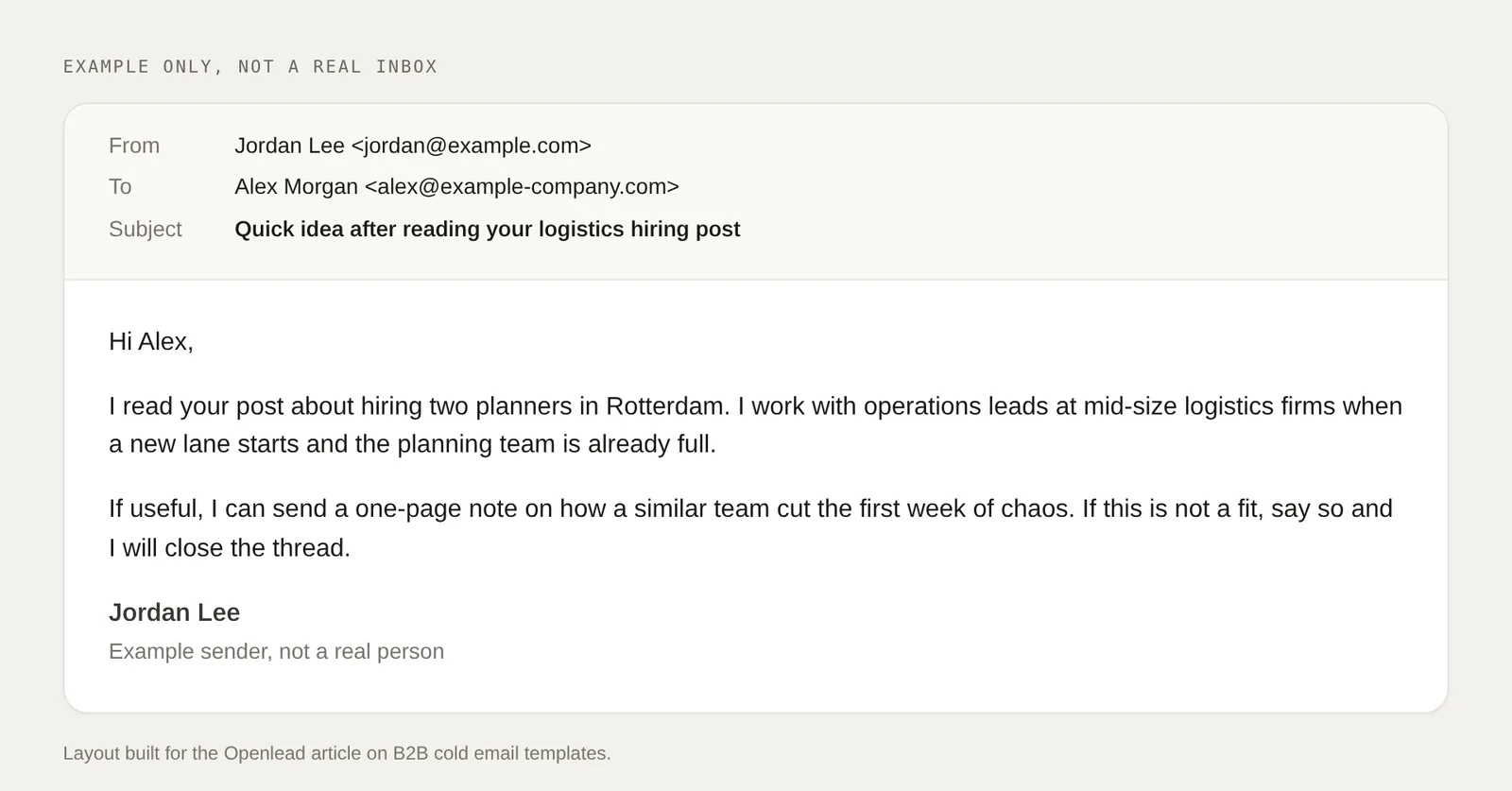
The layout above is a first note after a relevant hire. The subject names one fact (a hiring post). The body is three short sentences: why you wrote, what you can share, and a way to close the thread. The names and addresses are made up for this article.
Write from a list of companies that actually fit. Openlead can build that list from a sentence, with profile links for the people you then write to.
Subject lines to copy
-
[Role] at [Company]
-
[Page or product] on your site
-
Should I close this thread?
-
[Mutual name] suggested I write
-
[City] launch at [Company]
-
A one-page checklist for [team].
-
Idea for [team] at [Company].
-
Your [trial or download].
Keep the subject in line with the body. A teaser that doesn't match the email is a CAN-SPAM problem as well as a trust problem.
Common mistakes to avoid
-
Sending the same body to 500 people: First-name merge is a weak stand-in for personalization. If the first line is generic, the rest doesn't matter. - Leading with your product story: They don't owe you a narrative. Start with their company, then the problem, then a small ask.
-
Skipping the list quality step: A polished template on a bought, stale file still bounces. I would build the company list first (see lead finder if you need tools for that) and verify emails before you send. - No opt-out and no address: That's both rude and, in the US, a legal issue. Put a real postal address and a clear way to say no.
Turn your ICP into a list with Openlead
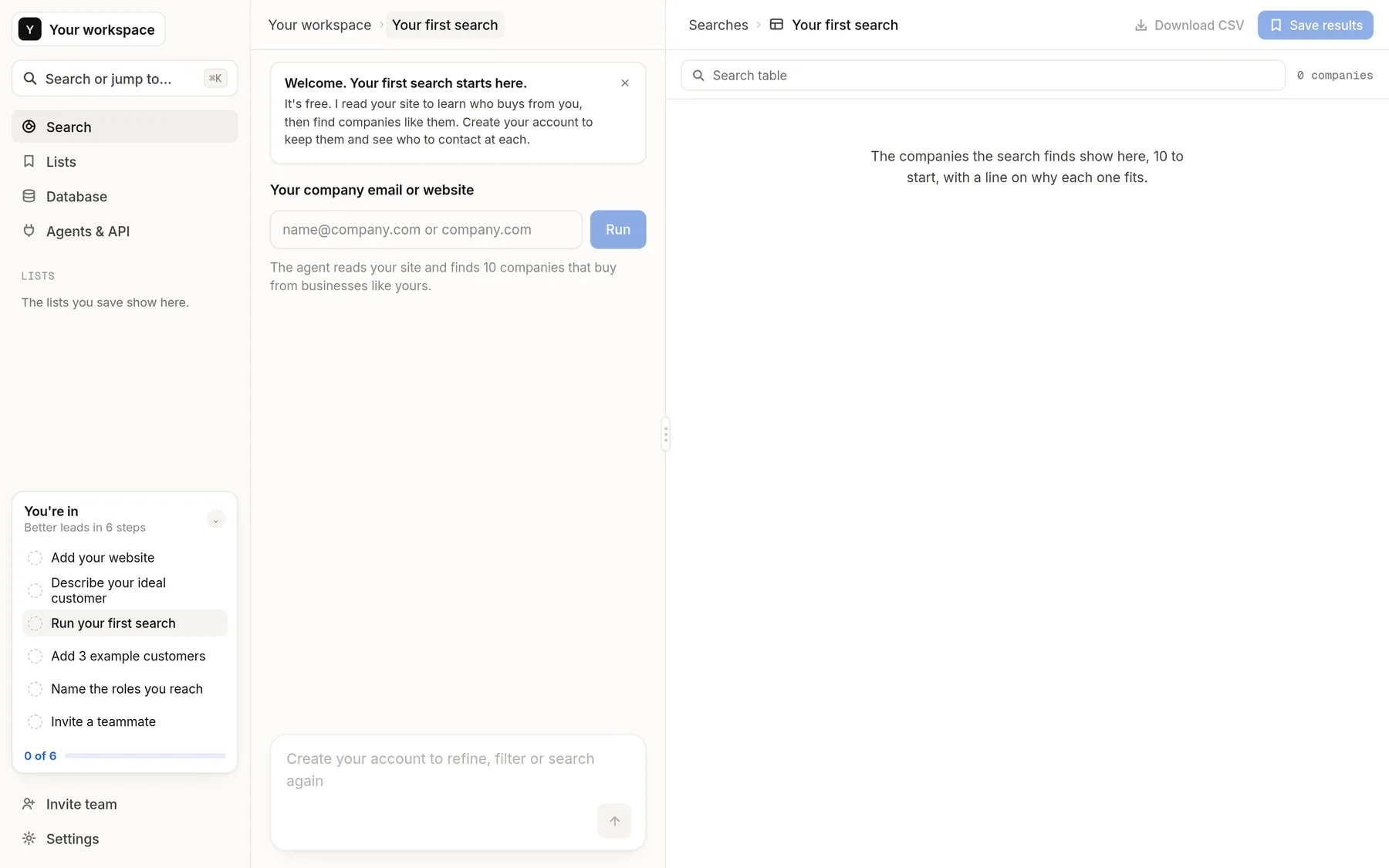
Before I paste any of these B2B cold email templates into a sequencer, I describe the ideal customer in Openlead. I get the companies that match, with 1 to 3 people at each and their profile links. Openlead does not give email addresses or phone numbers. It gives me a list worth writing to. Then I look up work emails only for those people.
Frequently asked questions
Do B2B cold email templates work?
Yes, when the list is tight and the first line is specific to the company. A generic template sent to a bought file usually doesn't. I don't have a single official reply rate to quote, because the rate moves with the list, the offer, and the domain.
How long should a B2B cold email be?
I aim for 50 to 125 words. Long enough to name one fact and one ask, short enough to read on a phone. If you need a second page, you don't have a first email yet.
What is a good B2B cold email subject line?
A good subject names the company, the person, or the trigger, and matches the body. "Idea for [Company]'s [team]" or "Should I close this thread?" beat a vague "quick question."
How many follow-ups should I send?
I stop at one or two follow-ups, then a short breakup note. More than that, on a true cold thread, usually trains people to ignore you.
Is cold email legal?
Yes, if you follow the rules in each country you email. In the US, CAN-SPAM still applies to commercial email. In the EU and UK, GDPR is stricter. This is not legal advice; check the rules that apply to you before you send.
About the author
Julian KrethFounder, Openlead


